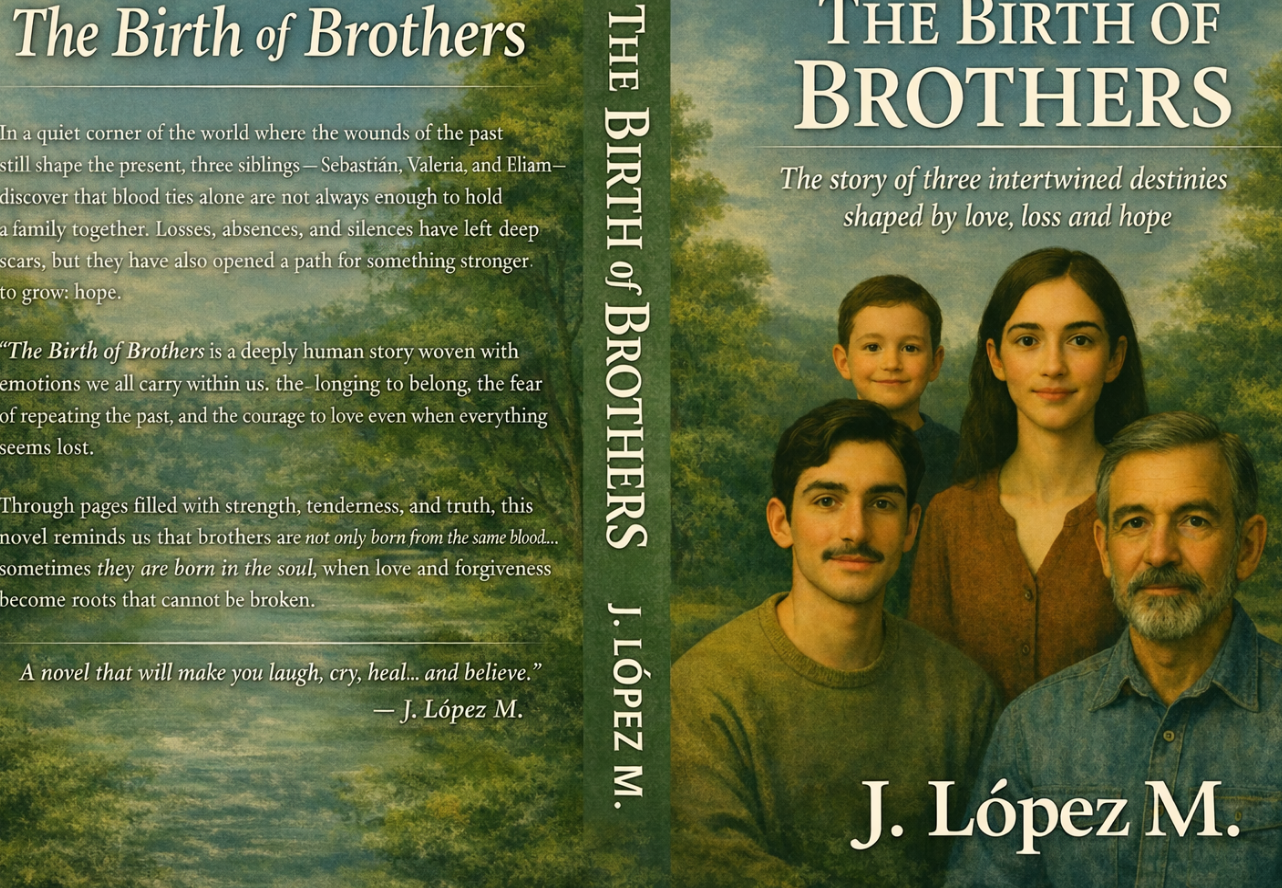
The Birth of Brothers — Cover
The Birth of Brothers
eBook ASIN: B0GSNNDZ3M | $4.99 USD
Paperback ASIN: B0GSQ6K8ZY | $15.99 USD
Publication date: March 15-16, 2026
Genre: Literary Fiction / Family Drama
Available on Amazon Kindle and paperback
Synopsis
"The silence between them wasn't hatred; it was pain. Because sometimes, loving a brother also means learning to lose him in order to find him again."
When Leopoldo discovers that two young strangers might be his long-lost children, a journey of redemption, pain, and hope begins.
Sebastián, marked by absence. Valeria, forged in silence. Eliam, the bridge between three souls destined to find one another. A powerful story about family, forgiveness, and second chances. The Birth of Brothers is more than just a novel; it is an embrace for the soul.
"The silence between them wasn't hatred; it was pain. Because sometimes, loving a brother also means learning to lose him in order to find him again."
The Birth of Brothers is a profound story about redemption, faith, and the love that survives even when everything seems lost. It is a novel that reminds us that no one is born knowing how to love, but we are all born seeking to be forgiven.
"There are wounds that only forgiveness can heal."
📖 Chapter 1 — The Boy Who Wanted to be Seen
In a rural schoolhouse with peeling walls and wobbly desks, the sun filtered in with impertinent curiosity. It was the third grade; Leopoldo, at nine years old and wrapped in clothes that were too big for him, spent his days stealing glances at Grethel. To him, she was not just a pretty girl; she was an unattainable dream, a mirage of neatness amidst his own disarray.
Grethel wore white ribbons in her hair, spoke with the confidence of someone who knows she is loved, and gave off a scent of expensive soap that contrasted with the smell of dry earth in the classroom. The daughter of merchants, she belonged to that world of new notebooks, snacks that tasted like the city, and shoes that shone under the sun. Leopoldo, on the other hand, was a thin, silent boy, his face marked by the harshness of the climate and his hands calloused by the fields. His uniform—a map of clumsy patches sewn by his grandmother—and his old backpack, smelling of corn, were the badges of his lack.
But scarcity did not hinder his devotion. He dedicated himself to the task of being rescued from anonymity: he would place wildflowers on Grethel's desk, hand her rudimentary drawings where the lineage was reversed—he, a prince; she, his princess—and he even memorized poems that he recited with a trembling voice, begging for a smile that would validate his existence.
However, Grethel never laid her eyes on him. Her gaze, instead, was captured by the teacher's son: a tall boy with impeccable hygiene and an easy smile. He was the owner of the leather ball, while Leopoldo kicked a sphere of old socks and frustration. Their closeness became absolute, and Leopoldo, from the darkest corner of the classroom, learned to swallow his rage and metabolize his sadness in silence.
During the sixth-grade closing ceremony, while the rest celebrated the end of childhood with the flashes of cameras, he remained anchored to a solitary bench, contemplating the empty court. It was there, on the periphery of others' joy, that he uttered his first decree:
"Never again will I suffer for a woman. To me, they will only be a pastime."
At twelve years old, Leopoldo was unaware that this promise, born of an unhealed wound, would transform into his own curse. He did not know that, by trying to protect himself from pain, he would become the architect of a trail of broken hearts, including, fatally, those of his own children.
A Word from the Author
This novel was born from the desire to explore the invisible threads that connect us to our origins. What does it mean to be siblings? Is it only blood that defines us, or is it the choice to stand together through the storms? In a world that often reduces family to a biological accident, I wanted to write a story about those who decide to love despite everything, about wounds that become bridges, and about forgiveness that arrives just in time to heal what seemed irreparable.
Through Leopoldo, Sebastián, Valeria, and Eliam, I invite you to reflect on the legacy we carry, the choices that define us, and the possibility—always present—of building a new home from the ruins of the past.
— J. LÓPEZ M.